Estratto dalla norma UNI 7129/2015
parte 3
Posizionamento del comignolo/ terminale di
scarico su tetti piani in presenza di ostacolo/
volume
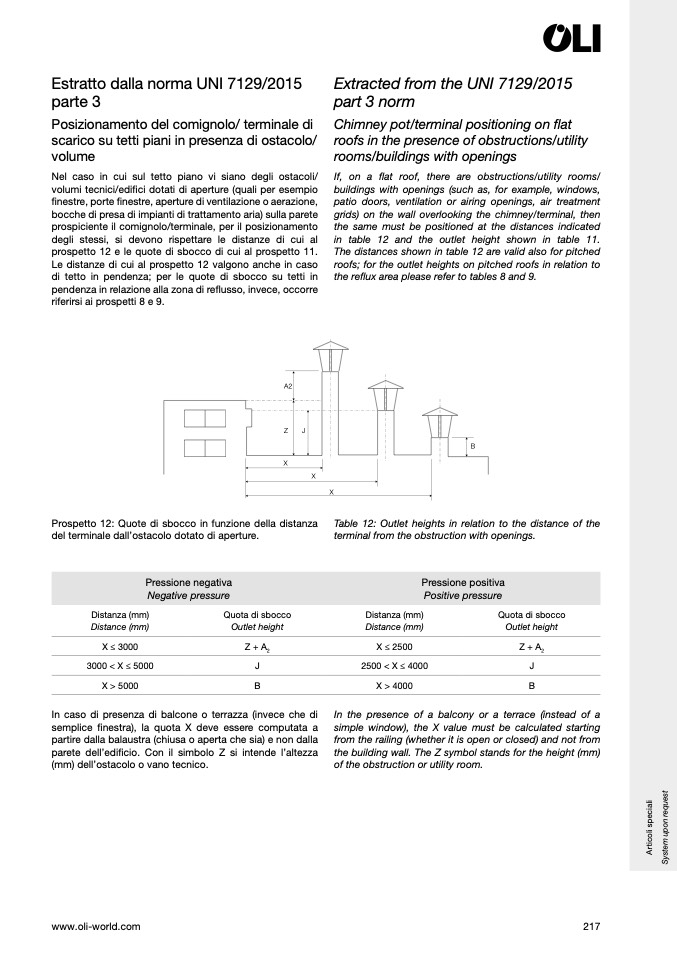
Nel caso in cui sul tetto piano vi siano degli ostacoli/
volumi tecnici/edi
fici dotati di aperture (quali per esempio
finestre, porte finestre, aperture di ventilazione o aerazione,
bocche di presa di impianti di trattamento aria) sulla parete
prospiciente il comignolo/terminale, per il posizionamento
degli stessi, si devono rispettare le distanze di cui al
prospetto 12 e le quote di sbocco di cui al prospetto 11.
Le distanze di cui al prospetto 12 valgono anche in caso
di tetto in pendenza; per le quote di sbocco su tetti in
pendenza in relazione alla zona di reflusso, invece, occorre
riferirsi ai prospetti 8 e 9.
A2
Prospetto 12: Quote di sbocco in funzione della distanza
del terminale dall’ostacolo dotato di aperture.
Extracted from the UNI 7129/2015
part 3 norm
Chimney pot/terminal positioning on flat
roofs in the presence of obstructions/utility
rooms/buildings with openings
If, on a flat roof, there are obstructions/utility rooms/
buildings with openings (such as, for example, windows,
patio doors, ventilation or airing openings, air treatment
grids) on the wall overlooking the chimney/terminal, then
the same must be positioned at the distances indicated
in table 12 and the outlet height shown in table 11.
The distances shown in table 12 are valid also for pitched
roofs; for the outlet heights on pitched roofs in relation to
the reflux area please refer to tables 8 and 9.
Z
J
X
X
X
B
Table 12: Outlet heights in relation to the distance of the
terminal from the obstruction with openings.
Pressione negativa
Negative pressure
Pressione positiva
Positive pressure
Distanza (mm)
Distance (mm)
X ≤ 3000
3000 < X ≤ 5000
X > 5000
Quota di sbocco
Outlet height
Z + A
2
J
B
Distanza (mm)
Distance (mm)
X ≤ 2500
2500 < X ≤ 4000
X > 4000
Quota di sbocco
Outlet height
Z + A
2
J
B
In caso di presenza di balcone o terrazza (invece che di
semplice finestra), la quota X deve essere computata a
partire dalla balaustra (chiusa o aperta che sia) e non dalla
parete dell’edificio. Con il simbolo Z si intende l’altezza
(mm) dell’ostacolo o vano tecnico.
In the presence of a balcony or a terrace (instead of a
simple window), the X value must be calculated starting
from the railing (whether it is open or closed) and not from
the building wall. The Z symbol stands for the height (mm)
of the obstruction or utility room.
www.oli-world.com
217
A
r
t
i
c
o
l
i
s
p
e
c
i
a
l
i
S
y
s
t
e
m
u
p
o
n
r
e
q
u
e
s
t

