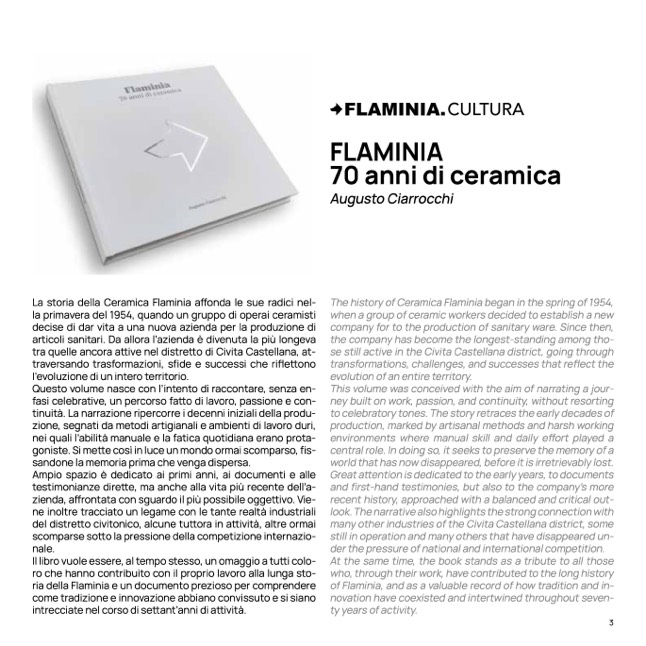
La storia della Ceramica Flaminia affonda le sue radici nel-
la primavera del 1954, quando un gruppo di operai ceramisti
decise di dar vita a una nuova azienda per la produzione di
articoli sanitari. Da allora l’azienda è divenuta la pi
ù longeva
tra quelle ancora a
ttive nel distretto di Civita Castellana, at-
traversando trasformazioni, sfide e successi che rifle
ttono
l’evoluzione di un intero territorio.
Questo volume nasce con l’intento di raccontare, senza en-
fasi celebrative, un percorso fa
tto di lavoro, passione e con-
tinuit
à. La narrazione ripercorre i decenni iniziali della produ-
zione, segnati da metodi artigianali e ambienti di lavoro duri,
nei quali l’abilità manuale e la fatica quotidiana erano prota-
goniste. Si mette cos
ì in luce un mondo ormai scomparso,
fis-
sandone la memoria prima che venga dispersa.
Ampio spazio è dedicato ai primi anni, ai documenti e alle
testimonianze dirette, ma anche alla vita pi
ù recente dell’a-
zienda, a
ffrontata con sguardo il più possibile ogge
ttivo. Vie-
ne inoltre tracciato un legame con le tante realtà industriali
del distre
tto civitonico, alcune tu
ttora in attività, altre ormai
scomparse so
tto la pressione della competizione internazio-
nale.
Il libro vuole essere, al tempo stesso, un omaggio a tutti colo-
ro che hanno contribuito con il proprio lavoro alla lunga sto-
ria della Flaminia e un documento prezioso per comprendere
come tradizione e innovazione abbiano convissuto e si siano
intrecciate nel corso di settant’anni di attività.
The history of Ceramica Flaminia began in the spring of 1954,
when a group of ceramic workers decided to establish a new
company for to the production of sanitary ware. Since then,
the company has become the longest-standing among tho-
se still active in the Civita Castellana district, going through
transformations, challenges, and successes that re
flect the
evolution of an entire territory.
This volume was conceived with the aim of narrating a jour-
ney built on work, passion, and continuity, without resorting
to celebratory tones. The story retraces the early decades of
production, marked by artisanal methods and harsh working
environments where manual skill and daily e
ffort played a
central role. In doing so, it seeks to preserve the memory of a
world that has now disappeared, before it is irretrievably lost.
Great attention is dedicated to the early years, to documents
and first-hand testimonies, but also to the company’s more
recent history, approached with a balanced and critical out-
look. The narrative also highlights the strong connection with
many other industries of the Civita Castellana district, some
still in operation and many others that have disappeared un-
der the pressure of national and international competition.
At the same time, the book stands as a tribute to all those
who, through their work, have contributed to the long history
of Flaminia, and as a valuable record of how tradition and in-
novation have coexisted and intertwined throughout seven-
ty years of activity.
FLAMINIA
70 anni di ceramica
Augusto Ciarrocchi
3

